Cortega sits between your agents and everything they touch — LLMs, MCP tools, databases, APIs — and enforces the boundary between what an agent is authorized to do and what it actually attempts. Not logged after. Enforced before.
Every request that reaches your agents carries verified identity — JWT, mTLS, or OAuth 2.0. Unauthenticated requests are blocked at the gateway. Virtual keys with full lifecycle management (create, rotate, expire, revoke) are standard — not Enterprise-gated.
Create, rotate, expire, and revoke keys per team, app, or agent. Full RBAC (viewer, admin, auditor). SSO via Okta or Entra ID. Not paywalled behind an Enterprise tier.
Check inter-agent calls against per-identity access policy before they proceed. Enforce delegation limits.
Agents receive only the permissions their current task requires, for the duration of that task. Least privilege enforced at the gateway — limits the blast radius of any compromised agent.
Access control check: is this agent permitted to call this tool? Argument check: do the specific arguments violate your policy, regardless of the agent's stated intent? Both must pass before execution. Neither is probabilistic.
Define which agents, users, and teams can call which tools, models, and MCP servers. Enforced at the gateway on every request.
Even if the agent is authorized, the specific call is inspected. Does it contain PII? Is it trying to access a restricted resource? Is the argument pattern anomalous? Fail-closed on ambiguity.
When an agent is about to take a consequential action, get a plain-English summary of what it's about to do. Record a documented approval decision, visible in your audit log.
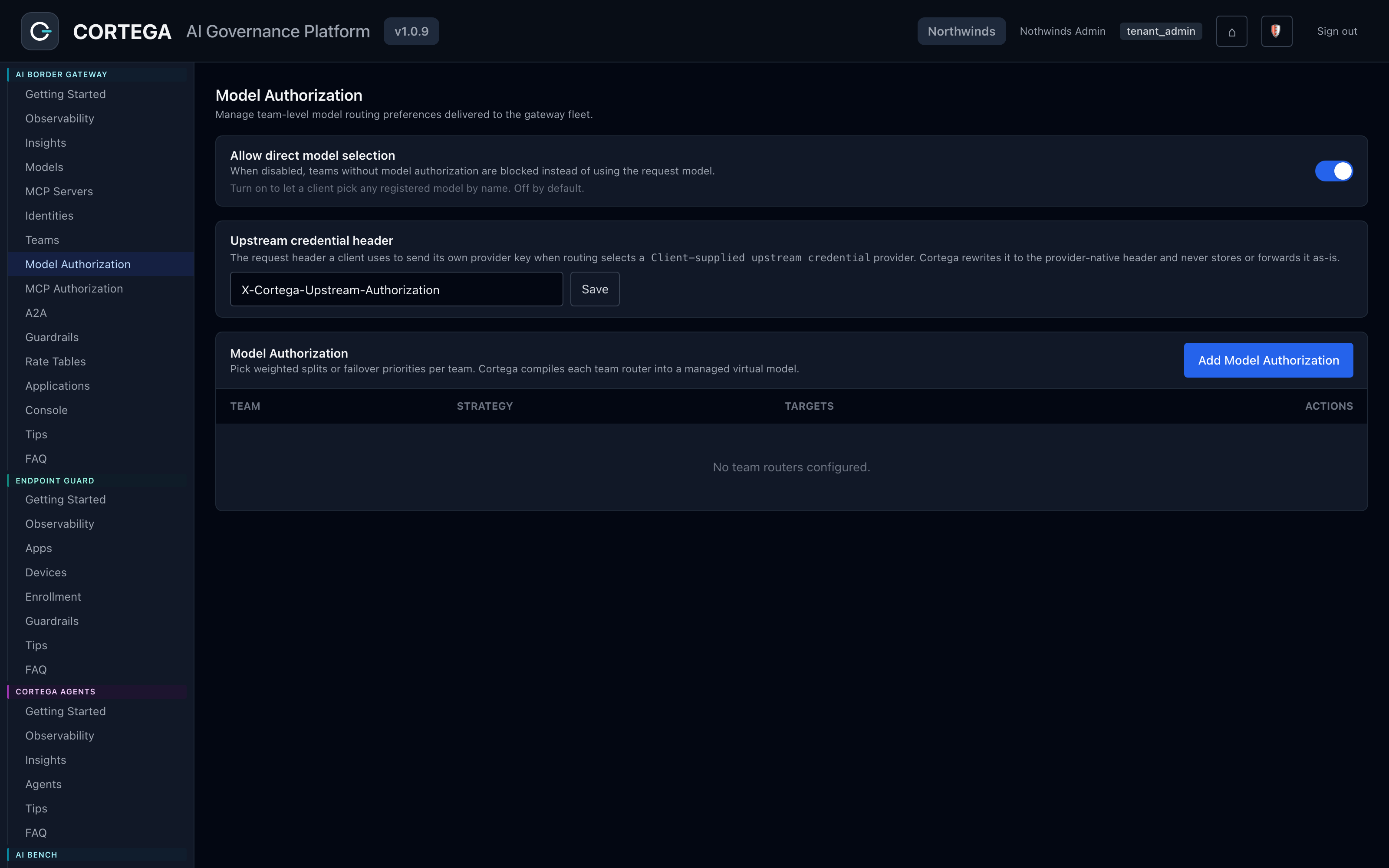
Every LLM call routes through Cortega's egress gateway. You decide which AI providers are approved and which models agents can use. Sensitive data can be detected and redacted before it reaches an external provider.
Define per-team, per-agent allow/deny lists for providers and models. Block calls to unapproved destinations at the gateway.
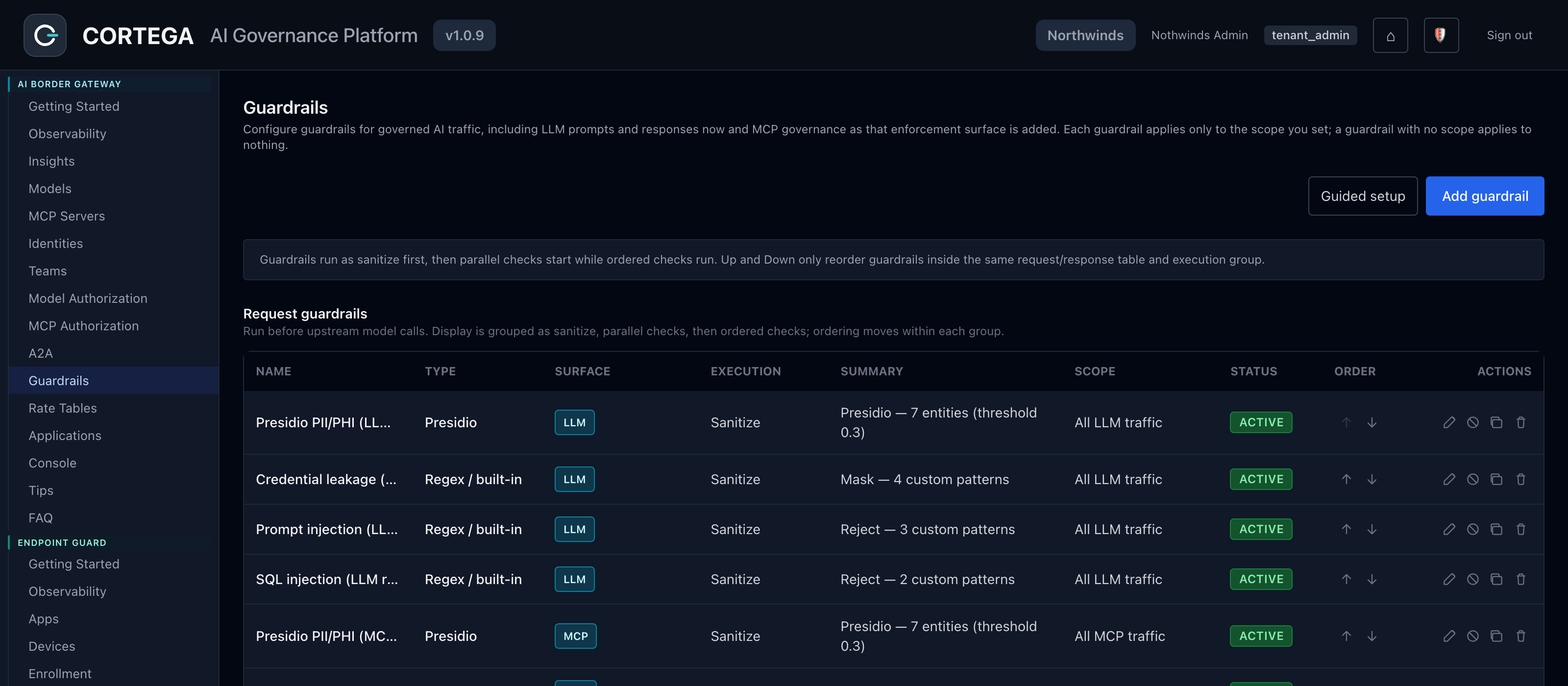
Local RE2 engine detecting PII and payment-card data (PCI), plus healthcare-adjacent patterns like medical license numbers. No data sent to a third-party scanner. No probabilistic LLM guessing. Ambiguity fails closed.
Guardrails scan model responses too — catching sensitive-data leakage, RAG leakage, and data exfiltration on the return path.
Team and provider budgets, enforced as hard blocks at the gateway, not after-the-fact alerts. Cortega also detects token velocity anomalies and recursive loop signatures, stopping Denial of Wallet attacks before they drain your API budget.
Set monthly budget limits at the team or provider level. Hard blocks, not alerts.
Enforced per principal. Prevents any single agent or user from consuming disproportionate capacity or triggering provider throttling.
Circuit-break on call frequency spikes, token velocity anomalies, and loop signatures per agent session. This is both a cost control and a security control.
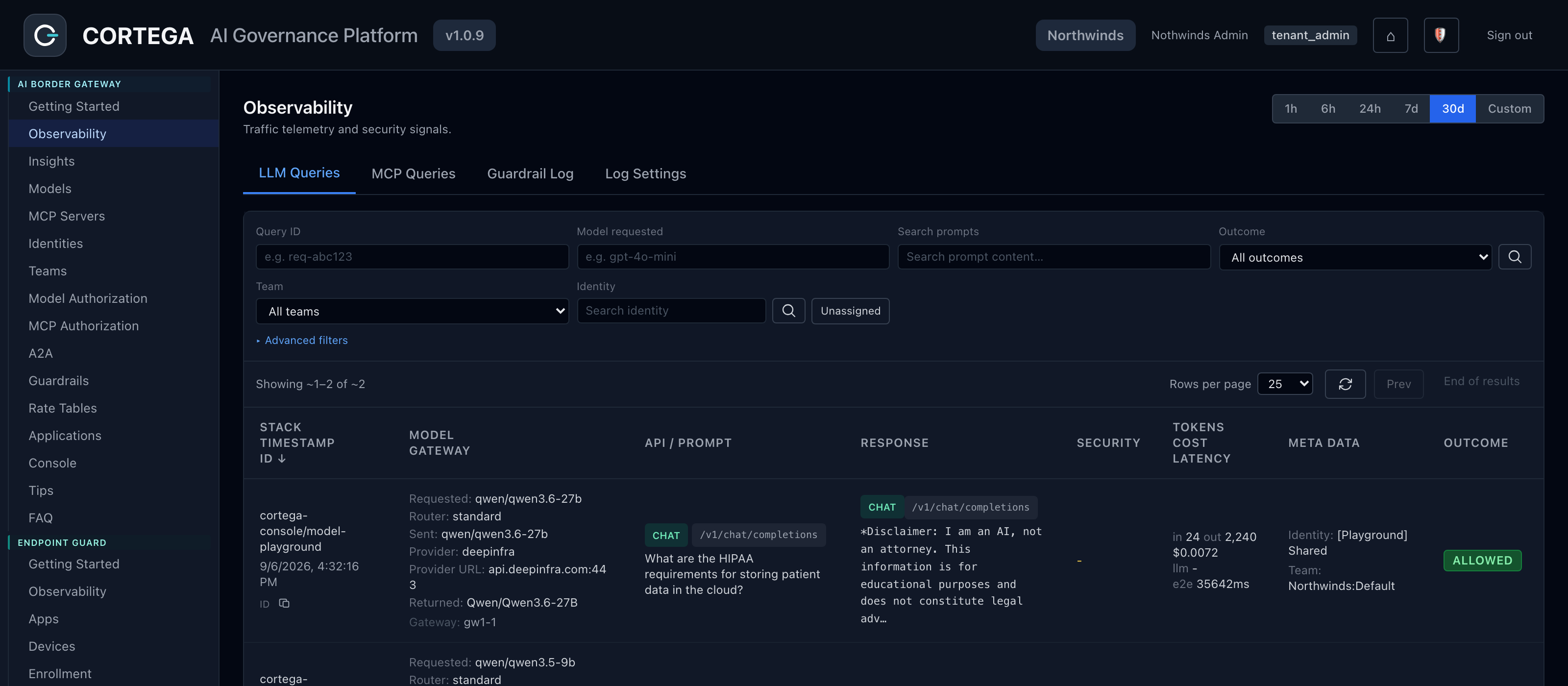
Deploy Cortega and show your security team the evidence before they sign off on a single agent.
Schedule an Architecture Review →