Where information is processed and kept
Prompts, documents, model outputs, embeddings, and the logs of all of them.
Sovereign AI means a government, agency, or company decides where AI runs, who operates it, which law applies, and what evidence exists afterward. Cortega AI Border Gateway sits between users, agents, and tools on one side and models on the other. It applies those decisions to every request and records what happened.
Delivered through Cortega AI Border Gateway with self-hosted models, in an air-gapped, in-country, or multi-jurisdiction deployment.
Data location is the first question and rarely the last. A regulator, a procurement office, or a security review will ask about each of these.
Prompts, documents, model outputs, embeddings, and the logs of all of them.
Which model versions run, who can change them, and whether they keep working if a vendor changes terms.
An owned server room, a cloud account in a named region, or a national GPU provider.
Law follows the operator and the legal entity as well as the data center. A foreign-headquartered provider can be subject to its home country’s law over data stored elsewhere.
Running through an outage, sanction, or vendor exit, and showing an auditor who used what, with which model, under which rule.
AI Border Gateway is the control point for every request. The table lists what it does for each requirement and what your team still has to provide.
| Requirement | What Cortega does | What you provide |
|---|---|---|
| Prompts and documents stay in region | Registers models served by vLLM or Ollama as providers and routes to them. The gateway, Postgres, ClickHouse, and Redis run in the environment you install them in. | The hosts, the network, the region choice, backups, and physical or cloud-account access control. |
| Only approved models | Per-team model access and per-tenant model visibility. Clients hold a virtual key; upstream provider credentials stay in the gateway. | The approved model list and the review process for adding to it. |
| No silent fallback abroad | Failover, weighted splits, and retries stay inside the models a team’s router lists. Requests do not move to a model outside that list. | Keeping every router entry, and every model used by guardrail judges and other auxiliary AI features, on approved providers. |
| Sensitive content handling | Presidio entity detection and masking, regex rules, and policy-document checks run as services in your deployment. Masking also applies to stored traffic records. | Detection patterns for national identifiers and local formats, tuned on your own data. |
| Audit and evidence | Records caller, team, model, route, guardrail result, and cost for each request in ClickHouse. Retention is set per install. A tenant can send an additional copy to its own OTLP endpoint. A disabled tenant can be purged from Postgres, ClickHouse, and Redis. | The retention period, the monitoring system, and the review procedure. |
| Separation between units | Tenants for ministries, countries, or business units, each with its own users, keys, budgets, guardrails, and model visibility. Each tenant’s device tokens use their own signing key, and each tenant can connect its own SSO. | The tenant structure and who administers each tenant. |
| Identity under your control | Integrates with your OIDC or JWT identity provider and maps token claims to teams. | The identity provider, its location, and its own sovereignty. |
| Tools and agents | Governs MCP servers with per-tool authorization, and reviews the tool calls an agent proposes against an allowlist. | Deciding which tools may reach data or systems outside the boundary. |
| Disconnected operation | An air-gapped license activates locally and never contacts the license service. Models and the gateway can run with no outbound dependency once installed. | Bringing container images and model weights across the boundary through your own transfer process. |
Everything inside the frame runs where you chose. A request leaves the boundary only on a route someone approved, and the gateway records it.
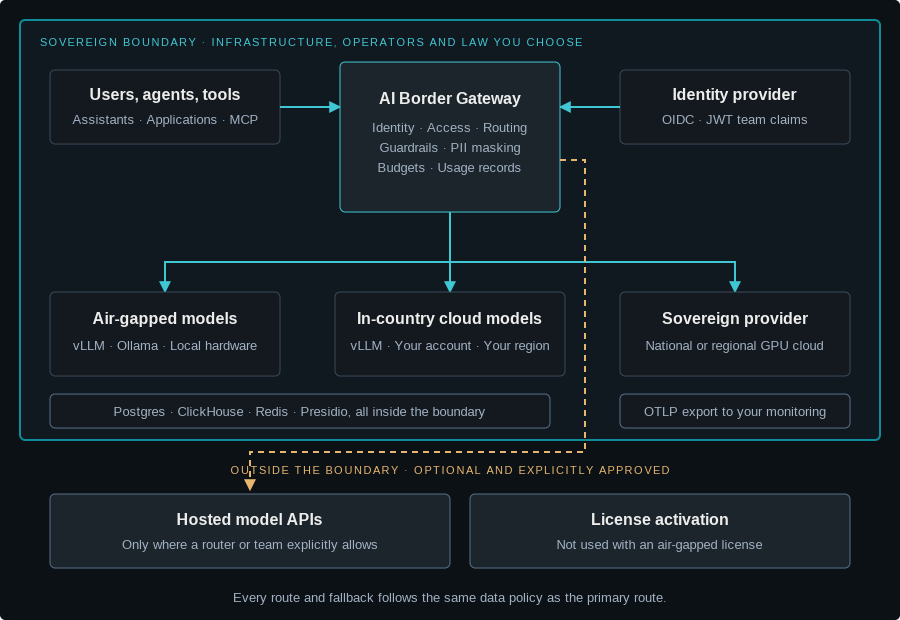
For classified, defense, or critical-infrastructure networks. vLLM serves open-weight models on local GPUs, the gateway and its stores run on the same network, and an air-gapped license activates without contacting Cortega. Images and weights arrive through your approved transfer path. The optional hosted Cortega Assist knowledge service stays off when its URL is left blank.
For public-sector and regulated teams that use cloud and need a named region and an operator under local law. Deploy the gateway and models into your own cloud account in that region. Cortega’s provisioning scripts target AWS, and a compatible GPU host in any other cloud works through the existing-host path.
For multinationals with different residency rules by country. Run a deployment in each jurisdiction with its own models, stores, identity provider, and guardrails. Each routes only to models approved for that country, so a fallback cannot cross a border.
For national or regional GPU clouds, telecoms, and system integrators that offer sovereign AI to many organizations. Host the models once and give each customer a tenant with its own keys, budgets, guardrails, and usage reporting.
Neocloud provider solutions →Sovereignty includes not depending on one vendor’s terms, pricing, or export position. The gateway separates what applications call from what serves the request.
Applications call a model name and a virtual key. Named virtual models route across one or more concrete models, so replacing or adding a model is a gateway change. Open-weight models run from weights you hold.
Priority tiers, health-based eviction, and same-request retry move traffic between approved models when one is down. A hosted model can be a lower tier only where policy allows it.
Model Intelligence filters to open-weight models and estimates hardware. AI Bench compares models on your workloads, and Red Team tests the chosen model and guardrails before rollout.
AI Bench →A sovereign claim holds only when the whole path holds. These points need a decision from your team.
Cortega enforces routing and records. Who administers the hardware, and under which country’s law, is set by where you deploy and who runs it.
Open weights do not always carry an unrestricted license. Check each model’s terms for your use, your sector, and your country.
Web search, MCP tools, browser extensions, and hosted fallback models can send data elsewhere even when the main model is local. Endpoint Guard routes supported assistants through the gateway. Its separate app-inspection path sends traffic on to its original destination and does not replace a hosted model with a local one.
A standard license checks in with Cortega’s license service, and installs download images and weights. Plan these steps, or use an air-gapped license and your own transfer process.
List the jurisdictions, operators, and data classes in scope. Decide which routes, if any, may cross the boundary and who approves them.
Pick open-weight models that fit the workload and run them on Ollama, vLLM on your GPU hosts, or vLLM in your cloud account.
Place AI Border Gateway and its stores inside the boundary. Register the model endpoints, connect your identity provider, and set team access, router fallbacks, and guardrails.
Run representative documents, tool calls, and failure cases. Check the selected model, the failover path, and the stored records. Use Red Team to test the guardrails before rollout.
Red Team →Sovereign AI
Bring the jurisdictions, data classes, and workload. We map them to a deployment pattern.