AI assistants are becoming indispensible tools for legal research. Lawyers have access to specialized AI assistants (e.g Harvey) or MCP plugins for general purpose AI assistancts (e.g ChatGPT)
What a plugin does
A plugin lives inside a specific assistant where you turn it on. It feeds that assistant more primary law so the model can research, and some of them can even look a cite up.
Every result still comes out of the same model, in the same chat. If the associate is in Claude, Harvey, Copilot, or a firm GPT, that plugin may not be in the path. If the user forgets to turn it on, nothing checks the answer!
Even when the plugin is on, retrieval does not finish the job. Stanford RegLab and HAI tested commercial legal research tools that retrieve from their own case-law databases before they write — the same retrieve-then-generate pattern as an MCP server. Hallucinations dropped relative to a bare chatbot. They did not go away. Lexis+ AI still produced incorrect or misleading information on more than 17% of queries; Westlaw AI-Assisted Research on more than a third. Many of those were not invented cases. They were real opinions cited for a proposition the opinion does not support.
In 2023, the lawyers in Mata v. Avianca filed ChatGPT-generated cases that did not exist. The court sanctioned them. The problem was not that ChatGPT lacked a research plugin. The problem was that nobody independently looked up the cites the model had already claimed. That second job is still there after you attach an MCP server.
What Cortega's AI Verifier does
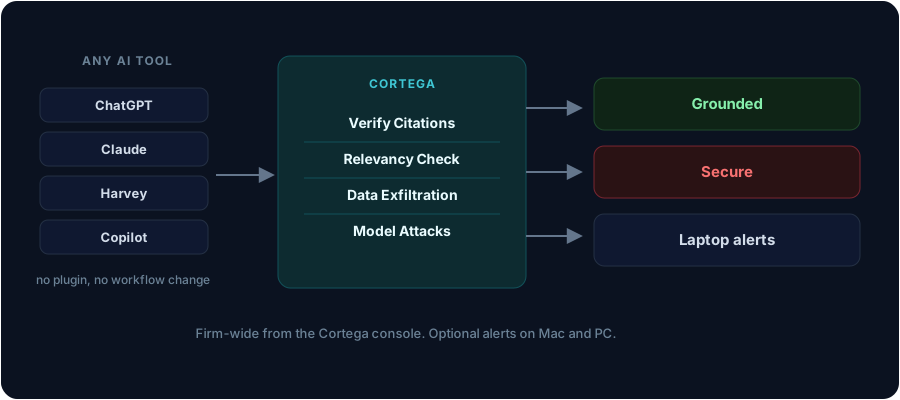
Cortega's AI Verifier keeps track of what the user submits. It looks up each AI answer (before the user sees it) against U.S. case law, federal regulations, patent grants, and Canadian legislation. Then it asks a second question the lookup alone cannot: does this opinion actually support the claim, and does it answer what was asked? That is the check the retrieval step does not do.
If the cite is fabricated, mismatched, or off-point, the check asks the original model to drop it and not invent a new one, then re-checks. That loop is independent of whichever tool produced the draft.
Two modes
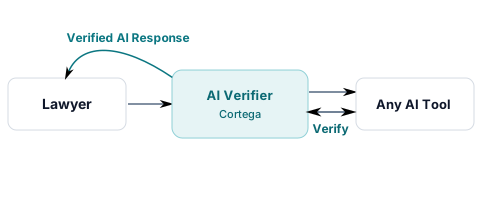
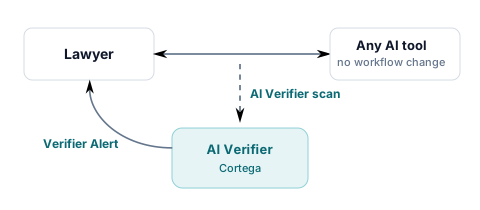
Firms do not all want the same interruption. Some want the bad cite cleaned before the lawyer sees the answer. Some want the lawyer to keep using ChatGPT or Harvey as they do today, with an alert on the laptop when a cite fails.
We built both. Inline sits in the path: lawyer to AI Verifier to the tool, retry and check in the middle, cleaned answer back. Alert-only leaves the workflow alone: the lawyer talks to any AI tool, the Verifier scans that traffic, and sends an alert.
The rest of the guard
A hallucinated cite is one failure. Accidental leakage of client matter into a public model is another. Cortega AI Verifier prevents unauthorized MCP tool calls and gives full visibility on each AI tool that is active in the firm.
Those checks belong in the same place as the citation check, on every AI tool the firm already uses, from one console, with no per-seat plugin to manage.
Cortega AI Verifier is also the only tool in the market with this technology that comes with a full AI Security solution that firms can deploy - on prem or in the cloud. Use of foundation or open weight models (airgapped or just open) is fully supported.
We wrote this up as a page for legal teams: Verify citations in every AI tool. The same check is live: run a brief through it.
If your firm turned on a ChatGPT research plugin this week, what is checking the cites that still come out of Claude and Harvey?
Follow-up: we ran OpenAI's published litigation prompts on Llama 3.3 70B and Claude Sonnet 4.5. The cites still failed a lookup and a relevancy check.