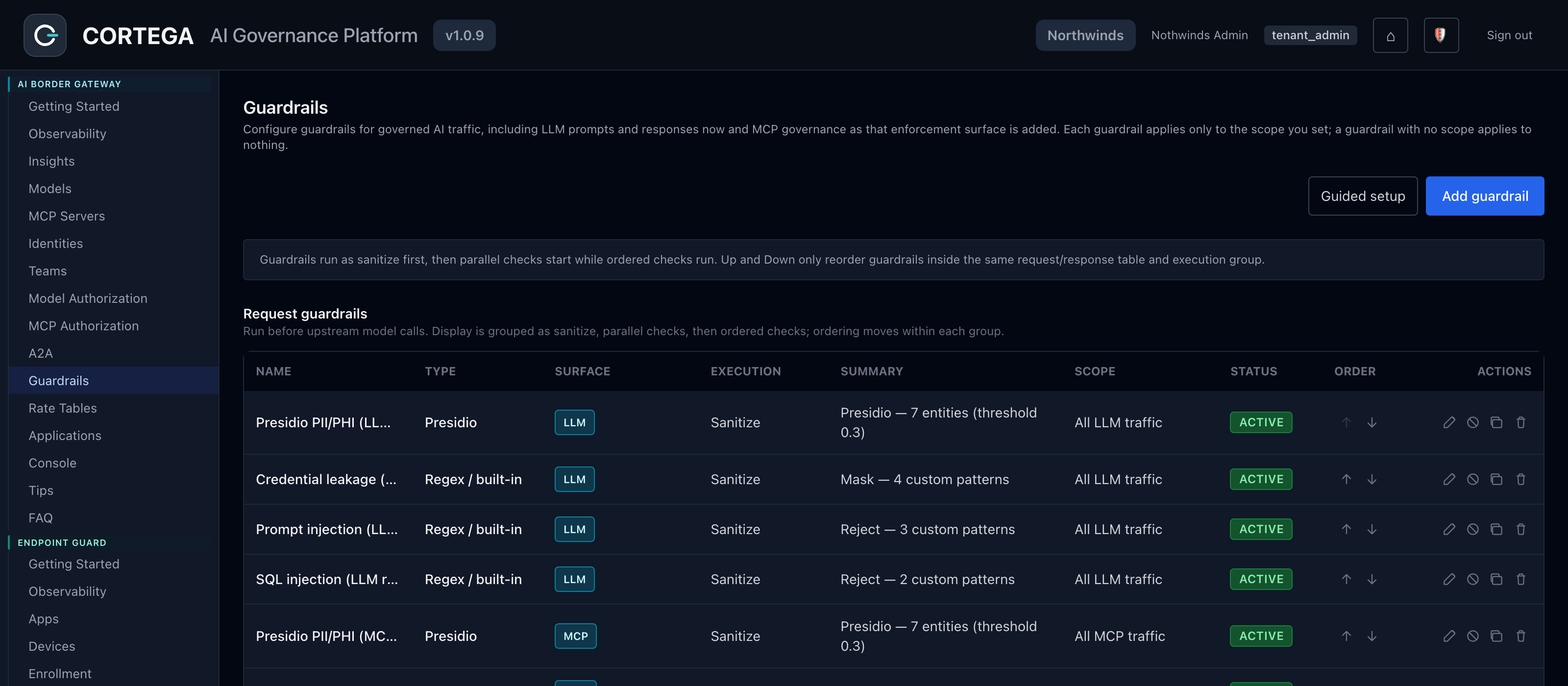
Cortega gives teams one place to observe AI use, apply policy, protect sensitive data, govern MCP tools, route models, and control cost. It is deployed on infrastructure you control, so AI governance does not require sending your traffic through Cortega's systems.
See pricingAI systems behave differently in production than they do in development. Models drift. Agents call tools. Prompts carry sensitive data. Costs move. Quality changes. Cortega models your intent and posture, watches how AI is being used, and applies policy in the path of real use.
See who is using AI, which models are called, what departments are adopting it, what tools are involved, and where strategy and execution differ.
Apply policy before the call completes. Block, redact, route, require approval, or record the event based on the intent you set.
Reduce exposure from prompt injection, sensitive data movement, unmanaged MCP tools, internal misuse, and unexpected agent behavior.
Manage model access, provider choice, routing, budgets, and cost from the same platform with guided setup and simpler configuration.
Cortega is built as an infrastructure layer. It separates data, control, and analytics so teams can govern Cortega gateways, work with other gateways, and turn AI activity into useful intelligence.
Run Cortega on your infrastructure. Keep prompts, responses, tool calls, and sensitive telemetry in the environment you control.
Verify callers, tools, models, providers, and policy before AI actions proceed. Treat every request as something that must earn trust.
Distributed gateways, central management, SSO, RBAC, audit evidence, standards-oriented telemetry, and operational controls, all in one platform.
Bring MCP servers, tool definitions, permissions, and tool calls into the same identity, policy, audit, and observability model.
Commercial providers, private models, and local LLMs are all governed the same way.
Understand what people are trying to do with AI, what they are worried about, where quality changes, and where adoption differs from strategy.
Cortega works across departments: revenue teams adopting AI with customers, operations teams improving service, engineering teams building agents, and governance teams responsible for risk. Start with the part of AI usage that matters most and expand from there.
Cortega AI Gateway governs the AI traffic behind products, internal services, agents, model gateways, and MCP tool calls. It gives platform, security, compliance, and business teams a single control point for production use.
Cortega EdgeSafe is an add-on for enterprise AI usage outside a single application. It helps teams bring browsers, endpoints, ChatGPT, Claude, internal agents, and other employee AI workflows into the same governance model.
Cortega AI Bench runs industry-specific safety suites through a chosen gateway and model, and scores whether your active guardrails block what they're supposed to, before and after every policy change.
Cortega Verifier (patent pending) checks whether a model's answer is backed up by your own documents and data. It catches a made-up or wrong answer before it reaches a customer, employee, or regulator.
Cortega supports the practical work behind AI Trust, Risk, and Security Management: visibility, runtime inspection, policy enforcement, data protection, access control, audit evidence, and continuous improvement. The goal is simple: let teams use AI while keeping the organization in control.
Define who can use which models, tools, providers, and actions. Keep policy consistent across teams and environments.
Model the outcome you want, then use that intent to guide policy, routing, approvals, and exceptions.
Record identity, policy results, approvals, data categories, models, and outcomes in a form teams can review.
We recently measured one Cortega gateway instance under fixed-rate load. The first report is published for teams that want to understand the overhead of putting governance infrastructure in the AI traffic path.
Read the performance noteProduction agents, employee AI tools, MCP servers, model access, sensitive data, cost, quality, or all of the above. We'll map the first useful control point.